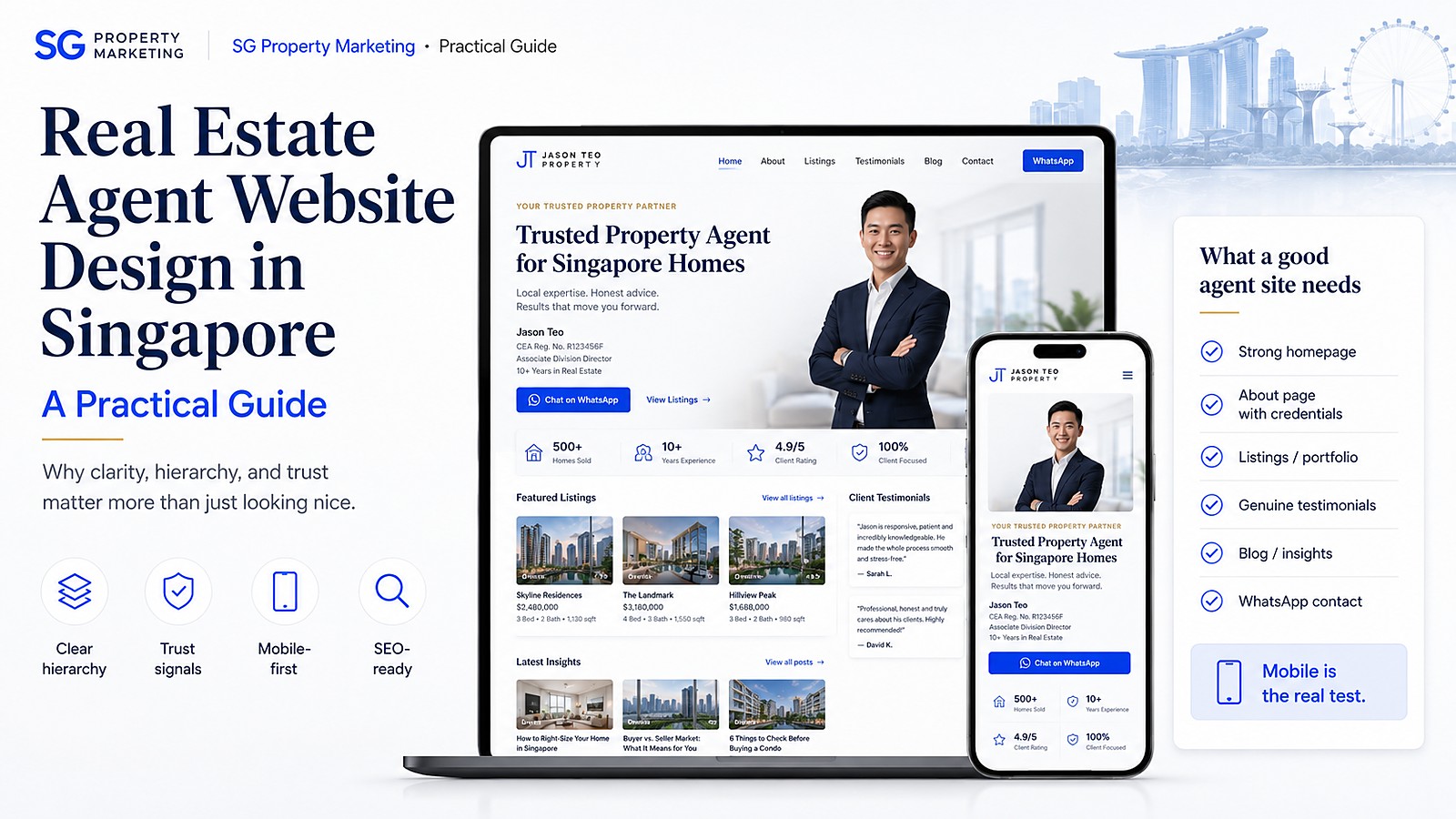
Good real estate agent website design isn't about looking impressive, it's about clarity, hierarchy, and trust. A well-designed agent site tells a stranger in seconds who you are, who you help, and how to reach you, backed by real proof, testimonials, past transactions, credentials. Everything else, colour, layout, imagery, exists to support that, not to decorate it.
Search "real estate agent website design Singapore" and most results talk about templates, themes, and page builders. Very few explain what the design is actually meant to accomplish. A website isn't a digital business card, it's the page that has to do the convincing when you're not in the room.
01 What good design actually means for an agent site
Design here isn't decoration, it's a sequence of decisions that guide a stranger toward trusting you enough to reach out. That means clear visual hierarchy (what should a visitor see first, second, and act on last), restrained use of colour and imagery so nothing distracts from the message, and enough whitespace that the page feels calm and considered rather than crowded. A cluttered site with ten competing elements signals the opposite of the professionalism you're trying to prove.
02 The pages every Singapore agent website needs
At minimum, a real estate agent website needs a homepage that states who you help and how in one glance, an About page that earns trust with your story and credentials (structure matters here, see the agent About page that earns trust), a listings or portfolio section, genuine testimonials, a blog or insights section that builds search visibility over time, and a contact page built around WhatsApp, not just a generic form.
Agents often ask whether they need a blog at all. The honest answer, it's what lets your site keep ranking for more searches over time instead of sitting static, and it's what feeds tools like ChatGPT and Google's AI answers when buyers start researching agents that way, which is increasingly common.
03 Design principles that build trust, not just polish
Three principles do most of the work: hierarchy, restraint, and consistency. Hierarchy means the most important thing on any page, usually your value statement and your contact method, is the most visually prominent, not buried under logos or stock photography. Restraint means picking one or two accent colours and using them sparingly, so nothing competes with your message. Consistency means the same fonts, spacing, and button styles across every page, small inconsistencies quietly read as unprofessional even when a visitor can't say exactly why.
Mobile is the real test
Most buyers in Singapore will see your website on a phone first. If your layout, buttons, and text aren't comfortable to use with one thumb, on a small screen, in bright daylight, the design has failed regardless of how it looks on a desktop monitor.
04 SEO that's built into the design, not bolted on after
Good agent website design and SEO aren't separate steps. Page titles, headings, and image alt text should be written with real search terms in mind from the start, not retrofitted later. Structured data (schema markup) helps Google and AI tools understand who you are and what you offer; we cover exactly how in Schema Markup Explained for Agents. And basic technical hygiene, fast load times, a working sitemap, clean URLs, matters more to your ranking than most agents realise.
05 Common mistakes that quietly cost agents enquiries
The most frequent issues we see: a homepage that leads with a logo or a slogan instead of a clear statement of who you help, no visible way to contact you above the fold, testimonials that are vague or unverifiable, a portfolio that hasn't been updated in over a year, and a site that looks nearly identical to every other agent's, because it was built from the same unmodified template. We go deeper on that last point in Why So Many Singapore Agents Look Identical Online.
Not sure your site is working for you?
Send us your website link and we'll give you a short, honest read on what's helping, what's hurting, and what to fix first.
Request a free audit →